51 years ago. The 1974 attempted kidnapping of Princess Anne.

This previously unpublished eye-witness account from former police firearms officer, Geoff Cadman, casts an intriguing light on a significant event in UK policing history and reveals a previously unknown secret.
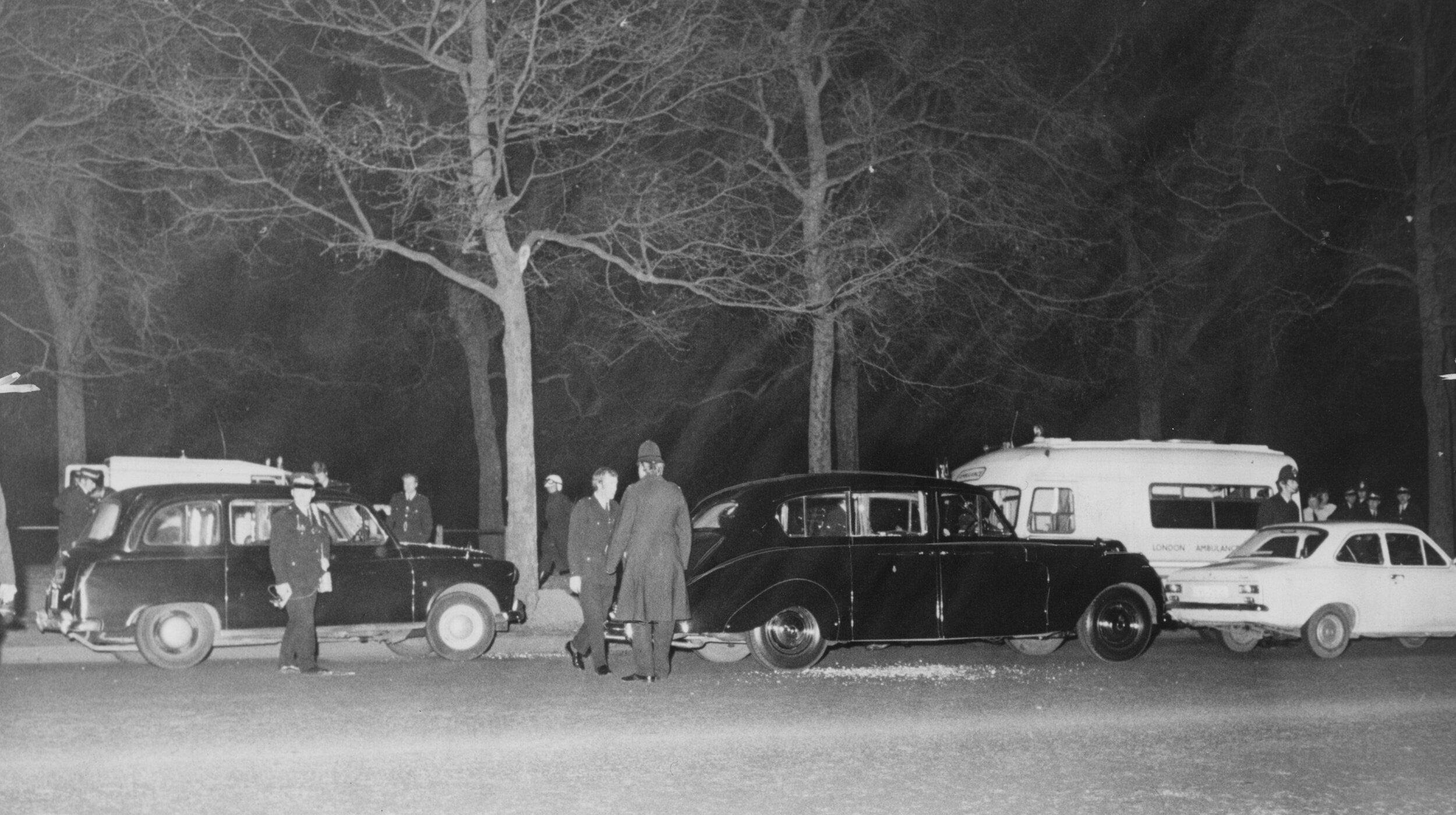
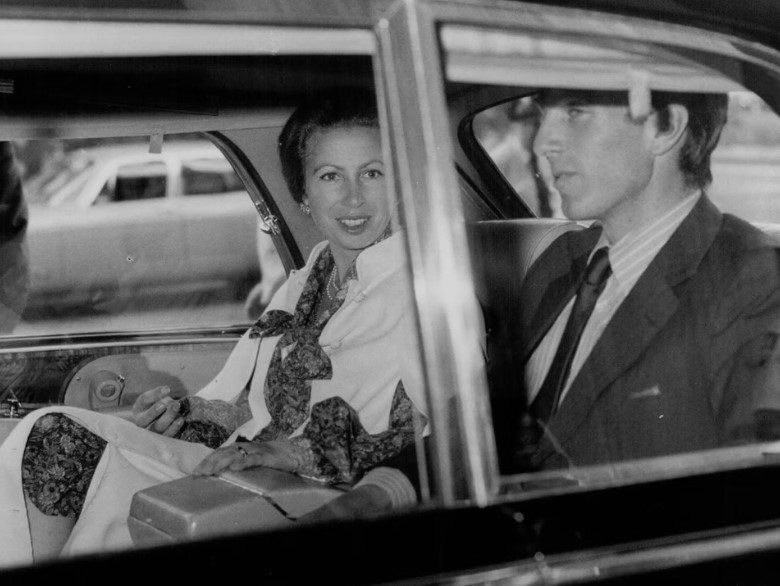
Photographs taken following the 1974 attempted abduction of Princess Anne showing her car and the Ford Escort used by the erstwhile kidnapper.

During the evening of March 20th 1974, HRH Princess Anne was in the back of a Vanden Plas limousine with her husband, Captain Mark Phillips. Up front, sat protection officer Jim Beaton, as they were being driven along The Mall towards Buckingham Palace.

Without warning, a white Ford Escort swerved in front of their car, blocking their path and forcing their chauffeur to bring the luxury car a rapid halt. A lone figure emerged from the Escort. He was holding a gun. Within seconds, both chauffeur and protection officer had been shot and disabled.

“I want you to come with me for a day or two, because I want 2 million,” her erstwhile kidnapper, Ian Ball, is said to have told the Princess as he pulled open the rear door of the Vanden Plas. With him, Ball had two pairs of handcuffs, Valium tranquillisers and a prepared ransom note for Queen Elizabeth.

“Not bloody likely,” Princess Anne replied.

A reporter, who recognised the Royal car, tried to intervene. Ball responded by shooting him in the chest. A police officer, Constable Michael Hills, then arrived at the scene and he too was shot in the stomach.

Surrounded by blood, injured men and broken glass, Princess Anne later told the police she wondered if she would have to fight Ball off herself. “It was all so infuriating; I kept saying I didn’t want to get out of the car, and I was not going to get out of the car,” she said.

The account that follows has not previously been published. An extract from his personal memoir, it was provided to me by former police firearms officer, Geoff Cadman and is reproduced with his permission.

Alpha Delta…I’ve Been Shot…

March 20th, 1974, two weeks after the General Election that ousted the Conservative Government of
Edward Heath, one of my colleagues, Pc Michael Hills, was on a 2-10 pm shift, patrolling on foot
near St. James’s Palace in The Mall.  It was dark, but Buckingham Palace was bathed in light, a few
minutes walk away; day or night it always impressed. Mick was young in service, still in his two-year probationary period.  A quietly spoken young man, he was always very smartly turned out and
sported a neatly trimmed beard.  It had been a fairly quiet shift with about two hours remaining, when
he heard what he thought was a car backfiring followed by a brief burst of raised voices.  He was
some distance away but decided to investigate and turned towards the noise.  Within a minute, he
could make out stationary vehicles and a familiar looking black limousine, a car of the Royal
Household. Mick reached for his radio, pressed the talk button and radioed Cannon Row to report that
he thought a Royal car may have been involved in a traffic accident and that he was going to
investigate.  The first reserve officer acknowledged the message and awaited an update.   The next
message that came over the airwaves was a chiller, ‘Alpha Delta from 736 I’ve been shot…. I’ve been
shot
’.

Unbeknown to Pc Hills, a man named Ian Ball had executed a plan that he had been developing for
several years. His intention was to kidnap HRH Princess Anne and demand a £3 million ransom.  Ball
was cunning and resourceful; he had also been diagnosed as schizophrenic and suffering from chronic
depression.  Despite his medical condition his plan was remarkably detailed, and he had even acquired
two handguns and plenty of ammunition; he was a very dangerous man. Earlier that evening he had
followed the Royal car containing Princess Anne, her personal protection office and her husband of
four months, Captain Mark Phillips. They had driven from their home to a scheduled charity film
event in the city. Having watched them arrive, Ball waited patiently for them to leave the cinema and
as they commenced the return journey he was again on their tail, looking for an opportune moment to
strike. As the veteran Royal car headed up The Mall, Ball knew his moment had arrived. He made his
move, accelerating past the slow-moving Daimler and then cut in front of it, braking sharply and
forcing it to stop.  He jumped out, guns in both hands, and confronted the chauffeur.  The Princess’s
personal protection officer, 31-year-old Inspector Jim Beaton, assumed it was an irate motorist and
prepared to intervene.  You might wonder why he did not report this immediately via radio. The
answer is simple, the Queen did not allow police radios to be fitted in her cars.  As Beaton approached
Ball, he failed to notice a handgun being pointed at the Royal chauffeur, even as Ball turned to face
him. It was very dark, and street lighting was minimal. Ball immediately fired two shots from a .38
revolver hitting Beaton in the shoulder, the bullet puncturing his right lung.  Even after the impact from the bullet hitting him at 900 feet per second, Beaton was unaware that he had been shot, let alone
seriously injured.  The human body is quite remarkable in how it deals with damage.

Armed with a 9mm Walther, Jim Beaton had undergone exactly the same basic firearms training as I
had, although it didn’t include wound ballistics or the effects of gunshot wounds. For those of us who
carried firearms on a daily basis, there was no body armour.  With the instant release of adrenaline into
his body, Beaton was reacting on instinct. He felt for his pistol. If he had performed his ‘make-ready’
drills correctly there would be a round ready and waiting in the breech, and with the safety catch off, it
only needed a squeeze of the trigger.  His drills were correct, and he drew the Walther and got off a
shot towards Ball, but it was not a good one.

Beaton, now in shock, was still unaware of his weakened right arm and so his shot was wide of the
mark, shattering a window as it entered the Royal car.  Some years later Princess Anne would recount
that near miss during a television interview.  Recalling the moment she heard the bullet hit the car and
shower her with glass, she was convinced the police bullet passed near her head; it may well have
done.  Still running on adrenalin, Beaton was trying to make sense of his predicament, but in these
moments of high stress the human brain’s superpowers come into play, one of which causes
something called perceptual distortion. Jim Beaton now realises he’s been shot and that he must fight
to survive but, in his own words, he was in a drunken-like state perceiving everything in slow motion,
not hearing properly because his brain was prioritising his actions, filtering out the unnecessary.  His
weapon drills came into play as he tried to re-position for a second shot.  As he brought the pistol up,
supporting his weakened arm by his fully functional one, he squeezed the trigger.  Nothing happened.
Looking down he noticed the slide half closed. The second bullet of seven had failed to feed fully into
the breech due to the magazine spring having failed to feed it into position. A fresh magazine was the
only option because from the moment he holstered that Walther at the start of his duty it was only ever
going to fire once.  Had both hands been fully functional he might have swapped magazines in
seconds, but Jim Beaton did not have those precious, life-saving seconds. The Royal chauffeur
suddenly grabbed Ball’s arm but was immediately shot in the chest at point blank range and
incapacitated – and all this was happening without the alarm being raised.  They were on their own.

Ball’s frustration was on the rise. He wrenched open the passenger door, reached in and grabbed the
Princess by the arm.  A tug of war started as Princess Anne refused to get out of the car.  Beaton made
one last gallant effort to protect the Princess.  It was adrenaline and will power that drove him to crawl
back into the Royal car and place himself between the Princess and the gunman who was still standing
by the door, frustrated and desperate.  Ball, still stood in the road, aimed his gun at Beaton who
instinctively raised his hand just as another shot was fired, the bullet shattering another window and
lodging in Beaton’s hand.  Ball then wrenched the door open and shot him a third time, the bullet passing through his stomach and intestines before lodging in his pelvis. It was Ball’s last shot with the
.38 – but he still had the second gun.  Beaton was now grievously wounded and in urgent need of
emergency surgery and still the alarm hadn’t been raised, but all that was about to change.  Enter Pc
Michael Hills.

Still unaware of the horror that was unfolding in the darkness, Mick Hills crossed The Mall from near
Clarence House, then home to Her Majesty The Queen Mother.  Coming up behind Ball he tapped
him on the shoulder just as someone shouted ‘gun’.  Ball turned and on seeing Hills immediately shot
him in the midriff causing the officer to stagger to the rear of the car where he passed the first
shocking radio message, “Alpha Delta, I’ve been shot”. The Reserve officer was my former tutor
constable Dick Lee who didn’t quite believe his ears and responded with, “736 say again” to which
Mick, now collapsed by the side of the Royal car, repeated his message adding as much information
as his racing mind and rapidly weakening body would allow. He had been shot in the gut from a .22
handgun, the chrome-jacketed high velocity bullet zipping through three layers of clothing and into
his abdomen before embedding itself next to his liver.  At last, the alarm was raised.  Hills showed
great presence of mind and his message to Cannon Row was immediately re-broadcast to police units
across Central London.  Assistance would be coming at last.  Cannon Row’s armed response vehicle,
call sign Alpha 102, happened to be in the rear yard and within seconds it was full of officers who had
dropped everything and piled in. It roared into Whitehall, a blue light and sound show, as other units
from neighbouring divisions were doing the same, the increasing sound of their approach sending the
message of hope Mick Hills was desperately waiting for; ‘hang on chum, we’re coming for you’.

Courage is not a clear-cut quality and although much aggrandised in novels or when such actions are
lauded in post incident accounts, often written by those who weren’t there, it manifests in many
ways.  Some have it in abundance, some definitely don’t, while it remains a latent quality in others
and there are many variables in between that can both incite or erode it.  Many acts of courage result
from an adrenaline rush enabling the responses of ‘fight or flight’ and, as was the case on this night, it
can be fuelled by scant information and an abundance of confusion.  The ironic expression often used
by American pro-gun owners, “when seconds count, the police are only minutes away” could not
have been more appropriate in this situation. My Cannon Row colleague Geoff Jackson recalled:
“I was working [in the reserve office] with First Reserve Dick Lee. It was coming up to 8pm, when a
radio call was made by PC Mick Hills “Alpha Delta, I think there has been an accident involving a
Royal car
”. Dick answered. I went to the front office to let the Station Sergeant Bruce Peardon know.
 Bruce let out a couple of expletives. As I re-entered the Reserve room I heard Mick on the radio
again, it was very serious, “Alpha Delta, I’ve been shot, I’ve been shot”.  I ran across the room to the
open window and leapt through to the inner yard and into the drivers’ room. I burst into the room where three of the drivers were sitting and shouted what was happening. We all ran to one of the
police cars and left Cannon Row at high speed for the Mall”.

With her personal protection officer critically injured, a uniformed police officer shot and
incapacitated and a useless police pistol lying in the road, things were not looking good for the
Queen’s only daughter.  PC Hills spotted Beaton’s Walther on the ground and picked it up with the
intention of having a crack at Ball, but he wasn’t firearms trained and even if he were the weapon’s
unserviceable magazine spring had rendered it useless.  Hills had a bullet in his liver, was bleeding
internally and coughing blood.  Now in shock, he too was out of the fight.  An intervention, divine or
otherwise, was needed to fill the critical gap until the rapidly advancing cavalry arrived.  Just when all
appeared lost, along came some unsuspecting members of the British public, soon to become heroes. 
Another chauffeur in a Jaguar had stopped just as Ball fired his first shots.  The driver, Glenmore
Martin, approached Ball and was threatened with the gun. He wisely backed away but had the
presence of mind to reverse the Jaguar right up to Ball’s car to block it in.  Then on seeing the injured
PC Hills lying in the road he immediately went to his assistance.  Two other members of the public
had seen the disturbance as they drove along The Mall in separate vehicles. Both stopped to
intervene.  Brian McConnell, a journalist, was passing in a taxi when he spotted the commotion and
ordered his driver to stop.  He walked over to Ball and tried to speak nicely to him, but Ball was in no
mood for conversation and fired another shot. Down went his fourth victim with a bullet in the chest.

Then came a knight-in-shining-armour by the name of Ron Russell, a six feet five inches tall amateur
heavyweight boxer.  He had seen PC Hills gunned down and with no thought for his own safety he
strode towards Ball who, having just shot McConnell, had returned to the Royal car still intent on the
kidnap. As The Princess continued to remonstrate with Ball, big Ron struck him a hefty punch to the
head, but it wasn’t enough to stop him; he turned and immediately fired his pistol.  The .22 bullet
narrowly missed Ron but hit the windscreen of a passing London taxi, a lucky escape for the
unsuspecting driver.  Ball then ran around the limousine after Ron who had now recognised the
Princess and was lifting her out with the intention of walking her to safety. Ball confronted Ron and at
arm’s length he levelled the gun at him.  Realising this was his ‘do or die’ moment Ron instinctively
delivered a mighty uppercut to Ball’s chin and down he went, just as police units arrived in a
crescendo of two-tone horns and squealing tyres. It was less than two two minutes after PC Hills
crucial radio message.  The scene that greeted those responding officers was utterly bewildering.  The
only thing they knew for certain was that a PC had been shot and a gunman was on the loose in the
vicinity. Geoff Jackson describes his arrival:
We all dived out and dispersed.  I saw a man sitting with his back against a tree; he was holding his
chest. There was a lady with him. This man was journalist Brian McConnell. The lady later
complained that police had taken a long time to arrive [she would not have known that the alarm had only been raised less than 2 minutes earlier] further up was a male lying on his back half on the
pathway with an injury to his right hand, which was bleeding. PC Steve Rose was looking after him.  I
ran up to the Royal Car where I saw the chauffeur. He was injured, still sitting in the driver’s seat. He
told me to go to the back of the car.  As I reached the door I stood back in disbelief as HRH The
Princess Ann said, “Get an Ambulance, get an ambulance quick”.  I told her that one had been called
already.  Princess Anne moved back into the car along with Captain Mark Phillips and her Lady in
Waiting.  My lasting memory of Princess Anne was that she was in ‘full colour’ and knew exactly
what she was doing. She was totally in control
”.

Geoff and his colleagues were acting on their initiative.  As with all fast-moving incidents, especially
where lives are at risk from gunfire or knives, there is no time to stop for a detailed briefing or to read
a policy manual; immediate action is required.  We called it planning on the hoof. There is always an
initial lack of cohesion that the casual observer might see as ‘chaotic’, but police officers are trained
to act on their own initiative as well as with each other.   More police units were arriving from several
directions including an Area Car with three PCs on board who, although they didn’t realise it, were
about to bring this dramatic incident to a desperately needed close. That Area Car, callsign ‘Delta 1’
was a powerful Triumph 2.5pi from Marylebone Lane police station and driven by PC Ivor
MacGregor QPM, a dependable and experienced officer. The R/T operator was PC Mick Ball, with 18
months service and in the back seat was a former cadet buddy of mine, PC Phil Harris, who had
completed his crucial first two years’ service that very day.  Phil recently told me of his part in the
incident, something that until now he had never openly discussed.  The story of Phil and his comrades
in Delta 1 shines a whole different light on the incident and deserves to come out of the shadows. Phil
takes up the story:
I was posted foot patrol that day from Marylebone Lane police station on the Marble Arch beat. 
Delta 1 had stopped for me to have a short break. Over the mains radio came a call to a ‘fight’ in the
Mall’ and immediately my ears pricked up albeit I wasn’t officially posted to Delta 1, but given how
near it was..Park Lane, Hyde Park Corner, Constitution Hill and into the Mall, I made the decision to
stay in the car as Mick accepted the call. We took off at speed and I remember hearing another
message from Cannon Row reserve room saying someone had been shot
”.

Phil’s words took me straight back to the buzz of Area Car duty. I know from personal experience the
feeling that hits you on hearing such a chilling message.  It’s like an electric shock; the physiological
reaction being automatic, commonly known as the ‘fight or flight’ response preparing you for action. 
There are no higher thought processes. Adrenaline is released causing the heart rate to increase, senses
are heightened, unnecessary functions like taste, smell, even hearing can be filtered out.  Time
becomes meaningless and things appear to play out in slow motion.  The officers responding to that
call chose the ‘fight’ response, as all good cops do, and they all knew they were racing into danger.

There was no clear picture of what lay ahead; the one and only call for assistance was a four second
radio message from a police officer who had just been shot in the gut and was struggling to remain
lucid. Delta 1 arrived mere seconds after Geoff Jackson, with other units close behind them.  As they
dived out of their car, all three officers had adrenaline coursing through their veins, with all their
senses working flat out. They acted quickly, cutting through the confusion, prioritising their actions.
Scanning the scene, they see a taxi; a fancy limousine with shattered windows, glass everywhere; an
empty Ford Escort; people lying in the road bleeding; one’s police; one’s slumped against a tree
bleeding; others are lying bleeding on the road; where’s the gunman; a dark figure gets to his feet;
someone shouts, “there he goes”. It was a very short pursuit; Ball had barely gone a few paces before
he was rugby tackled to the ground, spread-eagled; there’s a revolver in his hand. He’s quickly
disarmed. It’s all over in seconds.  Ian Ball, the highly dangerous chronic schizophrenic who had just
shot four people and attempted to shoot a fifth whilst attempting to kidnap Princess Anne was
detained at last, his rampage was over and yet those who had just caught him were still totally
unaware of the sheer magnitude of events that had taken place just ten minutes before. 

With Ball detained and disarmed, the breathless crew of Delta 1 took stock of the situation.  They
were still holding Ball on the ground, still full of adrenaline and breathing heavily, when a man in
plain clothes appears right next to them. Where did he come from? They didn’t see him before, but
then they probably wouldn’t have, totally focussed as they were in flattening Ball. He identifies
himself as CID. They get to their feet and realising this is definitely a job for CID, Phil hands their
prisoner over to him. He is Temporary Detective Constable (T/DC) Peter Edmonds who, with others,
escorts Ball to Cannon Row police station. Edmonds had been on duty with a Detective sergeant and a
plain clothes Pc driving in an unmarked CID ‘Q’ car.  These were essentially unmarked Area Cars,
high performance vehicles, always driven by a Class 1 driver also in plain clothes.  They had heard
the call for assistance and had immediately responded, arriving seconds behind Delta 1. Lots of very
serious incidents often have an amusing moment and this one was no exception. As Ball was being
marched out of the park to a police car, the taxi driver whose windscreen had just been shattered by
the stray bullet intended for Ron Russell, came storming up and gave the restrained Ball a right old
cockney dressing down for damaging his cab, having no idea of the enormity of what had just
happened; a surreal moment.  Several years later on the “Parkinson” TV show, Princess Anne would
describe Ball’s capture as him being “smothered by the local rugby team”, after which she was
quickly ushered from the scene by officers from Cannon Row, as Geoff Jackson observed:
“.. there was a commotion at the front of the Royal Car and several officers, some in plain clothes,
came past me with Ball and loaded him into the back of a Police Traffic Division car with my Cannon
Row colleague Alan Minis.  Geoff Fitzsimmons had got Princess Anne into another police car and
whisked her off at speed to Buckingham Palace”.

With the Royals safely inside Buckingham Palace and Ball in custody at Cannon Row, a different type
of hard graft was about to begin. A case against Ball had to be prepared starting with answers to some
basic but vital questions:  Who is this man?  Is he a terrorist? Was he acting alone? Why was he doing
this?  This would be a job for experienced investigators; one must remember that, in the eyes of the
Law, Ball was only a suspect who remained innocent until proven guilty.  Enter the CID and the
‘Guv’nors’. Geoff Jackson again:
More officers turned up of various ranks and took over the running of the scene. I was surprised at
how some had arrived, one being PC Alex Rozmus, who had been on duty at Wellington Arch police
station [Hyde Park Corner] and who’d raced to the scene on his own motorcycle, in his shirt sleeves
and minus a crash helmet.  A CID Car or ‘Q’ boat’ as we called it, had also arrived, and it was with
the plain clothes officers that we surveyed the scene, locating the weapons in the gutter. Inspector Jim
Beaton’s Walther seemed to be jammed with a round facing inwards jammed in the slide.  We also saw
a revolver and some empty cartridges. This all stayed where it was and kept secure waiting for
forensic support
”.

The following day the three officers from Delta 1 were stood before their boss (the Chief
Superintendent of D Division).  A highly respected man, he was clearly very proud of his three men
and having praised them for their actions he commented briefly about a discrepancy that he knew was
developing within the investigation team.  A few days later he had his personal driver deliver the three
officers to New Scotland Yard in his official car, a rare honour for the young constables. They had
been summoned to see the Commissioner, Sir Robert Mark.  Also present at this meeting was Peter
Edmonds, who they learnt had been immediately elevated from a ‘temporary’ to a ‘substantive’
detective as a reward for his part in the arrest.  Official photographs were taken of the ceremony with
the Commissioner commending his men.  Phil Harris recalled how DC Edmonds appeared
uncomfortable on meeting them.  The incident was world news but that would start to ebb, as news
generally does, however it would flow again at the subsequent trial and the award ceremonies at
Buckingham Palace.

Several days after his audience with The Commissioner, PC Phil Harris was seen by a detective from
the investigation team who wanted to discuss what he referred to as ‘discrepancies’ as to what had
taken place.  This must have caused some anxiety for the twenty-one-year-old officer and his
colleagues in Delta 1.  The statement that was released to the media, and which eventually became the
official account of Ball’s arrest, stated that T/DC Edmonds, “saw a man with a gun running across
St James’s Park. Edmonds gave chase and, although threatened with the gun, threw his coat over
the fugitive’s head, forced him to the ground and arrested him”? (The Daily Telegraph, March 15th, 2005 –
Obituary, Peter Edmonds). 

That was quite some discrepancy; hardly a smothering by the local rugby team as described by
Princess Anne.  As deferential as he was to the high-ranking detective, twenty-one-year-old constable
Harris remained steadfast as to what had happened and that his original statement, made before he and
his colleagues went off duty, was an accurate account of the events and therefore he had no cause to
correct, alter or add anything. There was no doubt that Edmonds was in close proximity to the pursuit,
because he quickly appeared next to Phil Harris and the Delta 1 crew whilst they were still holding
Ball on the ground.  He certainly assumed responsibility for the prisoner from the moment Ball was
handed into his custody by Phil Harris. So what happened in the ensuing stages of the CID
investigation that resulted in that alternative version being presented to the news media? This
information, with its juxtaposition of the actions of the Delta 1 officers and DC Edmonds, was
received with much surprise and indignation by Phil and his colleagues and may have explained the
discomfiture detected in DC Edmonds when they’d all met in the Commissioner’s office. One must
remember that they were all very young in service and that challenging their senior officers was out of
the question.  None of them were the type that would seek conflict.

Regardless of who did what the police got the right man, of that there is no doubt. Ian Ball had a
severe psychological disorder diagnosed several years before the attempted kidnapping and also had
several minor criminal convictions.  He had never been jailed for them, but neither was he
successfully treated for his illness.  Exactly how someone with a record of petty criminal offences and
a chronic mental illness managed to travel to Spain, obtain two firearms, lots of ammunition and then
smuggle them back into the UK was never fully established, but mental illness is something that
confronts the police on a daily basis.  After questioning and initial enquiries, Ball was taken to Bow
Street Magistrates Court.  I was on duty that day and as he was taken from the cells, I was among the
small group who escorted him across the yard to the van. He was bluntly asked, ‘why did you shoot
our mate
?’  With his expressionless eyes staring straight ahead and in a monotone voice he replied,
He was in the way.’ After what was quite a short period on remand in custody, he appeared before
Lord Chief Justice Widgery at The Old Bailey on charges of attempted murder, attempted kidnapping
and other serious crimes associated with that night.  After his plea of guilty, and on hearing from a
Home Office psychiatrist of his severe mental illness, he was sentenced to be detained under the
Mental Health Act in one of the UK’s three high-security psychiatric hospitals, where he remains to
this day.
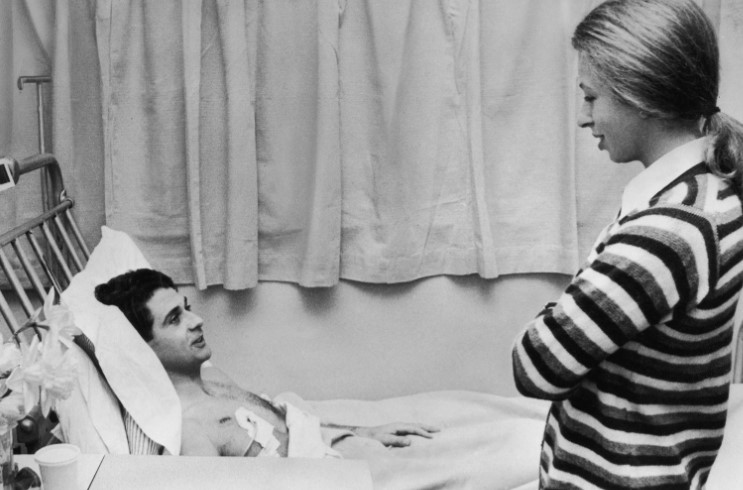
Princess Anne visits the badly injured Jim Beaton at Westminster Hospital.

In the aftermath, Inspector Jim Beaton was awarded the George Cross, sometimes referred to as the
civilian VC.  PC Mick Hills and Mr Ron Russell got the George Medal.  Mr. Callander the Royal
chauffeur, Mr McConnell the journalist and DC Peter Edmonds each received The Queens Gallantry
Medal (QGM).   The driver of the Jaguar, Glenmore Martin, got a Queens Commendation.  PC Phillip
Harris, PC Ivor MacGregor QPM and PC Mick Ball (Princess Anne’s local rugby team) received

Commissioners high commendations rather than The Queens Gallantry Medal as DC Edmonds had. 
Jim Beaton retired at the rank of Chief Superintendent having received an additional award from the
US Secret Service and is still drawing his hard-earned pension.  He is a quiet, unassuming and modest
gentleman and has publicly stated that the preparation he received for that role was virtually nil, apart
from passing the standard four-day firearms course. As for post incident trauma counselling, there was
no such thing.  Jim Beaton took three bullets protecting Princess Anne who through it all acquitted
herself with calm confidence; the epitome of grace under pressure. Beaton earned his George Cross
and was lucky to survive.  In the years that followed, police firearms training changed dramatically.
Today, the initial course to train an Armed Response Vehicle officer takes eleven weeks; for close
protection officers, which includes defensive/offensive driving, it is even longer. Radio
communication has improved dramatically.  Advanced first aid training in trauma management is
standard and the kit to deal with it readily available. An attempt at such a crime today would have a
very different outcome.

Ron Russell well and truly earned his George Medal.  Believing he would never part with it, he
eventually fell on hard times and was forced to auction it a few years ago, but it fetched £50,000,
much to his amazement and delight.  During a TV interview after the auction, he recounted the
moment he saw PC Hills getting shot, telling the reporter, “I thought, you can’t do that, that’s a liberty,
I can’t have that, you’re not getting away with that one
”, before wading into Ball. The interview
concluded with him saying how when the police arrived in strength after his heroic action he was,
thrown in the back of a Triumph 2000 with something over me head, like a cloth”.  Those officers
were acting on minimal information with no idea who or where the bad guys were, except for the
injured PC Hills who was in full uniform, so anyone not shot and bleeding would be detained as a
precaution.  As for something thrown over Ron’s head, there was only one other mention of that
particular tactic. The arresting officers would continue their careers in the Met.  Phil Harris ended a
varied and successful career at the rank of Inspector.  PC Ivor MacGregor’s long and exemplary
service would be recognised with the award of The Queens Police Medal.  DC Peter Edmonds QGM
became a career detective and would once again be involved in the pursuit of a gunman intent on
carrying out an armed robbery on a post office. DC Edmonds and a colleague would be shot at during
that pursuit.  Undeterred, they got their man.  Edmonds would receive seven Commissioners
commendations during his service, two of them for ‘outstanding courage’, leaving no doubt that he
was a tough, courageous and forthright officer.  After twenty-seven years’ service he took his pension
retiring at the rank of detective sergeant.  He should have enjoyed a long and well-deserved
retirement, but he tragically passed away three years later aged fifty-six. To my knowledge he never
spoke publicly of The Mall incident.

To reach a coherent and credible conclusion, this story needs to be considered in the context of the
intense scrutiny and reforms that the Met CID was being subjected to at that time.  Their reputation
for professionalism and expertise was world-renowned.  In the era I joined, the CID was widely
perceived as a ‘force within the force’, a powerful brotherhood. It was well known that if you wanted
to be a detective you had to apply early, as they liked to get their future detectives on board whilst
young in service. I was told that if you had more than eight years service you’d struggle to be
accepted. Senior detective officers were not to be messed with. Even middle ranking detective
inspectors were powerful figures within their own command and could make or break a detective’s
career.  The police generally, and particularly the CID, was not a place for ‘shrinking violets’ and that
remains true to this day. The Commissioner at that time was Sir Robert Mark, a former army officer
and D-Day veteran whose police career started in Manchester where he served as a detective sergeant
and inspector but was fast-tracked through the ranks becoming the chief constable of Leicester in
1957.  Ten years later he was in the Met and was made Commissioner in 1972.  But all was not well. 

There had been some serious corruption cases involving some very senior detectives, several of whom
were tried, convicted and jailed.  Mark promised reforms and his new broom started sweeping through
the CID with a vengeance.  Several hundred detectives were sacked or required to resign.   Many
others amongst the vast majority of good detectives suffered badly in the process by being transferred
to uniform posts, so it wasn’t surprising that the Commissioner was referred to by some in the CID as
‘Black Mark’. In short, the CID hierarchy were feeling bruised, indignant and threatened, a feeling
that permeated the department.  With their reputation badly damaged, the news media falling over
itself to hang them out to dry at every opportunity and with what many felt was grossly unfair action
taken against them by a Commissioner they resented, a siege mentality had developed. 
With that as a backdrop, one could argue that when the chance for some much-needed restorative
kudos presented itself in The Mall, the opportunity to grab it and run may have been irresistible.  Was
a friendly arm placed around Peter Edmonds’ shoulder with a quiet voice in his ear suggesting a nice
win-win? He too was a very junior officer, respectfully deferential to the upper echelons of a
hierarchical system. If that was the case, then faced with such a dichotomy, and on the cusp of his
passage into the CID, the pressure on him to comply would have been immense.

Do I believe the official account of the arrest that has the lone detective chasing Ball, being threatened
with the gun then throwing his coat over the fugitive and bringing him to the ground, with no mention
of the other officers?  No, I do not. I believe it is fanciful.  The statements of the Delta 1 officers
contained not a trace of bravado; on the contrary they were typical of most doers of brave deeds;
matter of fact and dismissive of their courage, knowing that in the company of their comrades
boasting was no route to popularity. Discrepancies aside, that rugby team hit the ground running with
no thought for their own safety and Edmonds was very close by. However, something happened to the post-arrest narrative that set aside the Delta 1 crew’s statements and denied them their rightful
recognition of a QGM. The military call that ‘stolen valour’. But their initial feelings of hurt and
indignation soon passed; they simply took it in their stride and got on with the job, satisfied that those
who really mattered to them knew and understood.  I, for one, remain immensely proud of them. 

In researching these events I have taken great care to write empirically and personally, setting out
each scene so that the story evolves coherently.  I mention this, in conclusion, for two reasons; the
first being a reiteration that the final moments leading up to Ball’s arrest that I have described, was not
what appeared in the press in the hours and days that followed; that account has remained the official
version, to this day. The second reason is that a TV documentary about the event was broadcast on
Channel 4 on June 25 th , 2023. The documentary included two key witnesses; Princess Anne’s former
protection officer, James Beaton GC and Ron Russell GM. Curiously, and perhaps crucially, it didn’t
feature any of the officers from Delta 1. In the programme, Russell stated that the first time he saw
Peter Edmonds was at the ceremony where they were officially congratulated. He stated, When I saw
him, I went and stood alongside him and I said, ‘You’re here under false pretences, aren’t you?’ And
he just looked at me and he went, ‘If you’re ever in any trouble, you don’t talk to anyone until you talk
to me.’ I said, ‘Fair enough.’ But I’ve never been in trouble, so I’ve never needed it. What he meant
by that is, don’t tell anyone else what you’ve just said.”

Falklands and Gulf War veteran, Captain Chris Craig RN, summarised my feelings about this incident
perfectly in his book “Call For Fire”when, in praise of his gallant team in The Falklands and first
Gulf War, he wrote, ‘the gap between those aglitter with medals and those who ‘merely’ fought is
often much smaller than folklore would have us believe’.

Geoff Cadman.

Reproduced with permission.

Unsung heroes

In the United Kingdom, police officers stand as sentinels of peace, safeguarding communities and upholding law and order. These men and women, often referred to as the “thin blue line,” are a family, a family that exhibits remarkable heroism and bravery in the face of adversity, dedicating themselves to protecting the public and ensuring justice prevails.

The origins of modern policing in the UK can be traced back to the Metropolitan Police Service, established in 1829 by then Home Secretary Sir Robert Peel. Peel’s principles of policing emphasised community cooperation, crime prevention, and professionalism, shaping the foundation of the UK’s law enforcement approach. From its inception, the police force has embodied these principles, with countless officers demonstrating extraordinary courage in their efforts to maintain public safety.

The tragic death of 46-year-old Sergeant Graham Saville will have hurt the police family. Few officers, serving or retired, will have known Graham personally, but all will recognise him for the job he did, the duty he performed and the risks he was prepared to take to save the life of a complete stranger. The reason, we’ve all been there. We’ve all asked ourselves how we would face that moment when duty requires you to risk your life to save another. We’ve all received training on risk, be it the live railway line, the burning building where people are believed trapped, the frozen lake where a child has slipped into the dark, icy water, the crazed sword wielding madman, the armed terrorist bent on murder, the suicide bomber, and any number of other times where police officers may be called to place themselves in harm’s way. Some of us have taken those risks and survived. Others are not so fortunate. But knowledge of their mortality doesn’t stop those young men and women from taking such risks.

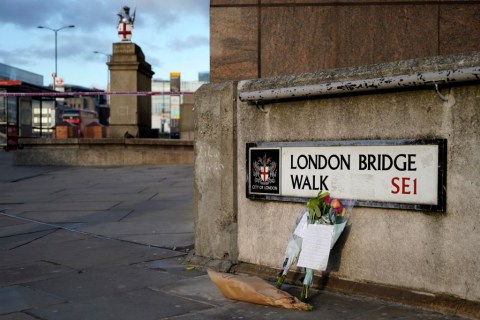
One remarkable example of heroism in recent memory is the response to the 2017 London Bridge attack. In the face of terror and an apparent suicide bomber , UK police officers demonstrated incredible bravery and selflessness.

Armed only with batons and minimal protective gear, several officers rushed towards danger, engaging the attacker carrying what appeared to be a bomb despite the imminent threat to their own lives. Their quick and decisive actions saved numerous lives and prevented further tragedy. These qualities reflect the real character of the men and women of our police services and the commitment, and dedication they exhibit each day.

While high-profile incidents like London Bridge and this week’s death of Graham Saville highlight the extraordinary courage of UK police officers, countless instances of bravery occur daily, often away from the public eye. These unsung heroes respond to emergencies, diffuse tense situations, and protect vulnerable individuals. From intervening in domestic violence situations to rescuing individuals from accidents, their willingness to place themselves in harm’s way for the greater good remains unwavering.

Tragically, some police officers will pay the ultimate price in the line of duty. The UK remembers these fallen heroes through various memorials and ceremonies. The National Police Memorial, located in London, stands as a solemn tribute to officers who lost their lives while serving the public.

These memorials serve as poignant reminders of the risks officers face and the sacrifices they make to ensure the safety and wellbeing of their fellow citizens. The next time you pass one of these, do stop for a moment to think what they represent.

The heroism and bravery displayed by UK police officers reflects an unwavering commitment to upholding the principles of justice, safety, and public order. From confronting immediate threats in high-stress situations to fostering trust within communities, these officers exemplify the true essence of public service. As the custodians of peace, they navigate complex challenges with courage, empathy, and professionalism. The police is a service that has rightly come in for significant criticism of late when some, not fit to wear the uniform, have been exposed. However, we who do not run towards danger, who are not called to enter that burning building or frozen lake or, indeed, to pull a man from the path of an oncoming train; we must remember the legacy of Sir Robert Peel’s principles lives on through their actions, reminding us that the “thin blue line” is not just a symbol, but a steadfast embodiment of bravery in the face of adversity.

Sergeant Graham Saville, I salute you. As I salute each and every police officer prepared to do the job you did.

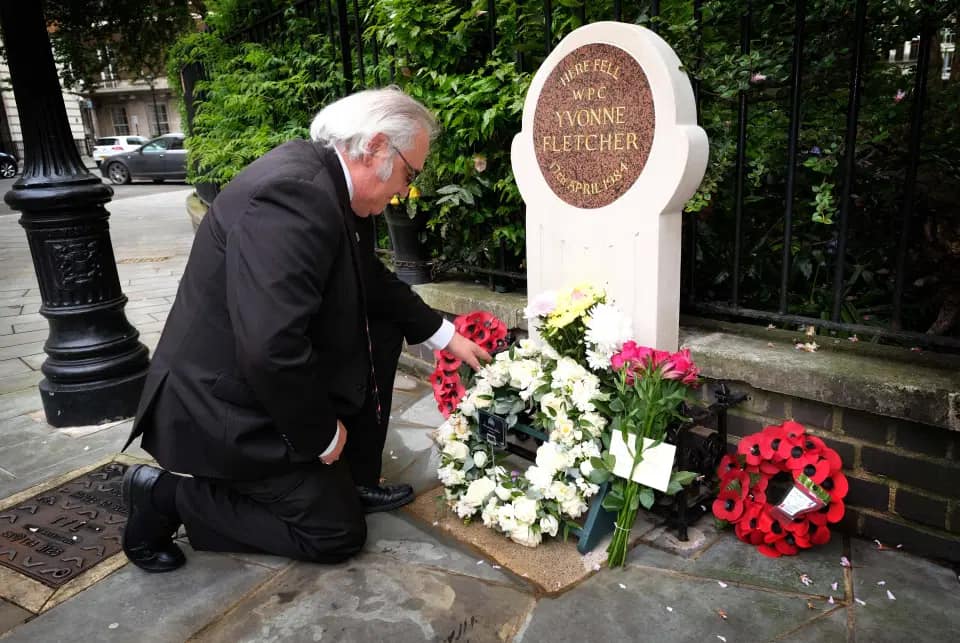
The photograph above shows former PC John Murray at the first police memorial, dedicated in 1984 to the memory of WPC Yvonne Fletcher. The story of Yvonne’s murder and of John’s incredible 40-year campaign to secure justice for her has now been published. It’s called No Ordinary Day. More about it here.

Betrayal and Manipulation: The Devastating Politicisation of the Thin Blue Line

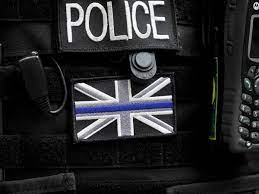
The recent decision by the Metropolitan Police to ban the wearing of the thin blue line badge has stirred significant controversy and debate. A symbol that has traditionally been used to represent solidarity and support for law enforcement officers, and a salute to those killed in the line of duty, the thin blue line badge, featuring a black-and-white union flag with a blue line, has become a popular national symbol representing the role of law enforcement as a barrier between the monsters and the weak, a force separating society from chaos and disorder. Supporters argue the badge symbolises respect for the fallen and appreciation for the difficult and often dangerous work performed by police officers.

And, I would argue, to assess the probity of this badge or patch, it is very relevant to consider when and how the expression ‘thin blue line’ first became popular. It was about twenty years ago when a United States marine called Michael Marks wrote a poem by that name, reputedly while sitting in a shell-hole during a tour of Iraq. The poignant ending to that poem resulted in it becoming hugely popular in policing and military circles.

These are final words of that poem; –


The decision by the Met to ban the public wearing of this patch at a demonstration has prompted discussions regarding the implications of its display, potential political affiliations, and its impact on community relations. In February this year, it was reported that a Nottingham based police officer had been referred for possible disciplinary action following a complaint by a member of the public alleging the thin blue line patch he had been wearing was now ‘associated with racism’ following its misuse at a protest against a Black Lives Matter rally in the United States. Rather than choosing to robustly defending the officer concerned or to point out that no such association exists in the UK, local senior officers chose to ban all local officers from wearing the patch.

It wasn’t long before political agitators and critics of the police jumped on the bandwagon to use this precedent to attack other police services in the UK. Their rather disingenuous argument maintained the suggestion that the thin blue line symbol had increasingly been associated with the aforementioned undesirable political ideology present in the US. It was said that, in some instances, the patch has been adopted by groups with controversial or divisive agendas, leading to concerns about the potential for the symbol to be seen as a statement of opposition to a number of social justice movements. If the police wore the patch, it was claimed, they were associating themselves with that ideology.

As Nottingham had done before them, senior officers in the Met caved in to this view. The ban they imposed appears to be an attempt to address concerns about perceived bias or favouritism within law enforcement, their acceptance being that the display of the badge could indeed suggest an affinity with such ideologies and, therefore, a lack of impartiality and fairness that could erode trust between the police and the communities they serve.

Not all Chief Officers have shared this view with one or two of the bravest being prepared to stand up and defend the badge for what it truly represents. The Met decision, however, raises complex issues surrounding symbolism, political associations, community relations, and trust. While the ban may be intended to address concerns about bias and impartiality, it also risks alienating officers and their supporters, driving a wedge between rank and file officers and management. Is it the case that the hijacking of a police patch by a group in the United States should have such an immediate and telling impact on thinking and decision-making in the UK? Is this a reflection of the manner in which policing has become increasingly influenced and controlled in accordance with political expediency rather that public desire and need? Or is this a line in the sand, a point at which the police service needs to stand up and be counted?


Even twenty years ago, the police service in the United Kingdom was regarded as a pillar of impartiality and professionalism. In recent years, however, concerns have been raised in many quarters over the increasing politicisation of the police, their priorities, their style of management, their performance and their ability to deliver the quality of service the UK public is entitled to expect.To understand the current state of affairs, it is important to examine the historical context. The UK’s police service once operated with a strong emphasis on political neutrality and independence. This principle was enshrined in what the Baroness Casey report recently referred to as ‘Peelian Principles’, reputedly established by Sir Robert Peel, the founder of modern UK policing.


Factors such as increased political scrutiny, constraining legislation, the introduction of Police and Crime Commissioners, budget cuts, and government demands for specific outcomes have raised justified concerns about the erosion of police independence.


Several incidents have highlighted the politicisation of the police service. One notable example is the handling of very kind of demonstration that saw the removal of thin blue line patches. The police’s inconsistent response to politically charged gatherings has drawn criticism, with accusations of biased treatment based on political leanings. This has fuelled concerns the police are being directed to prioritise political considerations when maintaining public order with what might be described as ‘light-touch’ policing applied only where political expediency supersedes a need to maintain public order.


The appointment of senior police officers has also come under increasing scrutiny. Critics argue that the selection process is now too greatly influenced by political considerations, compromising the meritocratic principles that should guide these appointments. Similarly, the ease with those Chief Officers who have demonstrate a reluctance to accede to the demands of their political masters, have been dismissed has contributed to a growing feeling that the credibility and independence of the police service is effectively compromised. Toe the line, Chief Constable, or I’ll replace you with someone who will.

The politicisation of the police service has had far-reaching consequences for public trust and confidence. The impartiality and fairness of the police are fundamental to their effectiveness in maintaining law and order. When the perception of bias (for whatever reason) takes root, public trust in the police is eroded. This can lead to reduced cooperation, reluctance to report crime, and a breakdown of community relations – all factors we see present in today’s society.

Several factors have contributed to the politicisation of the police service. One is the increased centralisation of power in policing, with policy being set and decisions being made at national level rather than locally. This concentration of power has made the police service more susceptible to political interference. Another is budget cuts which have put pressure on police forces, making them more vulnerable to political influence. When resources are limited, there is inevitable temptation to prioritise certain issues or appease political interests to secure funding or support.


Is it too late?

To address the issue of politicisation, it is crucial to reinforce the principles of independence, impartiality, and accountability within the police service. This might be achieved through greater transparency in decision-making processes, robust safeguards against political interference, and clear guidelines on the handling of politically sensitive situations. Moreover, a renewed commitment to the training and education of both politicians and police officers on the importance of political neutrality and impartiality is essential. This would help foster a culture that values professionalism and integrity above political considerations. The issue preventing this, however, is political will. Now our police service has been brought under political control, will our politicians ever be prepared to allow it to regain its independence?

Or is the banning of the Thin Blue Line badge a symptom of a service broken beyond repair?


For more on the history of police independence, when the Peelian principles were first brought into question and how our police services were systematically brought under political control, please do read No Ordinary Day – how one of the greatest tragedies in UK policing history triggered the end of an independent UK police service.

No Ordinary Day – available from today!

The truth behind the murder, in 1984, of WPC Yvonne Fletcher, and how events that day shaped the future of UK policing for the next four decades.

On 17th April 2024, it will be forty years since the greatest tragedy and the longest siege in UK policing history. Today, 8th June 2023, sees the publication by Ad Lib of No Ordinary Day.

Below are links to enable you to purchase the book. Matt Johnson and John Murray will also be appearing at CrimeCon on 10th June, at Hatchards, Piccadilly on 27th June and at the Bow Street Museum on 29th June.

No Ordinary Day reveals, for the first time, why two gunmen opened fire on demonstrators outside the Libyan People’s Bureau, how the attack was planned, who carried it out and who gave the orders. And it reveals why, in the aftermath of the attack and with the attackers under siege, the UK Government were so keen to avoid prosecutions and have the perpetrators removed from UK soil.

Hatchards

Waterstones

W H Smith

Hive

Amazon UK

Are cops supposed to be perfect?

When God was creating police officers he was into his 6th day of overtime when an angel appeared besides him and said, “Boss, you appear to be having a bit of trouble with this one.”

God replied, “Have you read the job profile for this one? Police Officers have to be able to run for five miles through alleys and fields in the dark, climb walls, enter houses that pest-control people wouldn’t touch and do all this without creasing their uniform or looking dishevelled. They have to be able to sit in an unheated, unmarked police car for at least eight hours without needing a toilet, then stand out in the pouring rain guarding a crime scene that night. Physically, they should be supremely fit, ready to deal with anything at the drop of a hat. And this peak of fitness must be maintained on a diet of black coffee, cola and half eaten hamburgers and pizzas. Oh, and they must have six hands.”

The angel shook her head slowly and said “Six pairs of hands…. isn’t that a bit difficult?”

“It’s not the hands that are causing the problem,” said God, “it’s the three pairs of eyes that they’ve each got to have.”

“Is that on the normal police officer?” asked the angel.

God nodded. “One pair for seeing through bulges in clothing to identify potential threats, a second pair in the side of his head to watch out for the safety of his colleagues and a third set to look reassuringly into the eyes of a badly injured person whilst the mouth convincingly tells the necessary platitudes.”

“God,” said the angel, touching his sleeve, “Perhaps you should rest and carry on working tomorrow?”

“I can’t,” said God, “I have already managed to produce a model that can wrestle a 16 stone belligerent drunk into the back of a small police car without using excessive force and without upsetting anybody else. It is programmed to feed a family of five on an exceptionally low salary.”

The angel slowly walked all round the partly formed police officer and then turned to God and asked, “Can it think?”

“You bet,” said God, “It can recite the definitions of multiple offences, give the caution with no hesitation, detain, investigate, search and arrest violent offenders in the street in less time that it takes for the CPS to debate the legality of his actions…and it retains its sense of humour. This officer also has phenomenal personal control. Dealing with crime scenes that would sicken an abattoir worker, coaxing a confession from a child abuser, comforting the family of a murder victim are part of the job specification. The sad thing is this, that the police officer then has to read in the paper that he is insensitive to the rights of criminal suspects or convicted offenders.”

The angel was quiet for a minute or two before bending over and running her finger across the cheek of the police officer. She looked at her finger and said to God,

“There’s a leak. I told you that you were trying to put too much into one person.”

“That’s not a leak,” said God, “that’s a tear…”

“What’s the tear for?” asked the angel.

“It’s for bottled up emotions, for a multitude of sad sights and occasions, for killed, injured friends and colleagues, for a misplaced faith in humanity, and for an unswerving dedication to duty and truth.”

“You are a genius … a tear,” said the angel.

God looked at the police officer for a minute, turned to the angel and said,

“I didn’t put it there.”

Out tomorrow.

No Ordinary Day – the truth behind the murder of WPC Yvonne Fletcher.

Available through all booksellers.

What is justice?

One day, at one of our law schools, a learned professor walked into a lecture hall ready to address a large assembly of law students.

He looked around.

“You there in the 8th row. Can you tell me your name?” he said, pointing to one student.

“My name is Sandra” she replied.

The professor turned and indicated the exit. “Please leave the hall,” he said. “I don’t want to see you in my lecture.”

Everyone remained quiet, stunned by the unexpected development. The student, although clearly irritated, slowly packed her things and stood up.

“Faster please,” the Professor called to her, impatiently.

Meekly, her head bowed, the female student left the lecture hall.

The professor kept looking around.

The remaining students appeared scared. Some glanced at their friends, uncertain what had happened or whether they too had transgressed in some way and would suffer a similar fate

“Why are there laws?” the Professor said, as the students settled down.

There was no response to the question. Once more, students looked at each other. Some lowered their heads, seemingly concentrating on their note books, desperate not to incur the wrath of this unpredictable tutor.

“What are laws for?” the Professor asked again.

“Social order,” came a tentative voice from the back row

Another brave student spoke up. “To protect a person’s personal rights,.” she called out.

“So that you can rely on the state,” said another voice.

The professor appeared unmoved.

“Justice,” called out a student from the anonymous centre of the assembly.

The professor smiled.

“Thank you very much, ” he said. “Tell me. Did I behave unfairly towards your classmate?”

Everyone nodded.

“Indeed I did,” he continued. “So, why didn’t anyone protest? Why didn’t any of you try to stop me? Why didn’t you want to prevent this injustice?” he demanded.

Nobody answered.

The Professor smiled again. “What you have just learned, you wouldn’t have understood in a thousand hours of lectures if you hadn’t lived it. Despite the apparent injustice, you didn’t say anything on behalf of your fellow student because you weren’t affected yourself. This attitude speaks against us and against life. People generally think as long as it doesn’t concern them, it’s none of their business. I’m telling you, if you don’t say anything today and don’t bring about justice, then one day you too will experience injustice and no one will stand up for you. Justice doesn’t just exist. We have to fight for it.”

“In life and at work, we often live next to each other instead of with each other. We console ourselves that the problems of others are none of our business. We go home and are glad we were spared. Justice is about standing up for others. Every day an injustice happens somewhere, in public and in private. Relying on someone else to sort it out is not enough. It is our duty to be there for others. Speaking for others when they cannot.”

The Professor then asked the ejected student, who had been party to the his ruse, to return to the lecture hall.

This was a simple lesson, to young lawyers who’s role it would become to speak up for others. There is a lesson here for society, however. It’s one we fail to heed at our peril.

New book – CROW 27

Click on the image to secure your copy.

Inspired by a true story.

Four young women soldiers. One veteran cop.

It begins as a fight for justice. It will end as a battle for survival.

When Detective Inspector Robert Finlay is sent to a military barracks to investigate a connection to weapons discovered in the possession of London gangsters, he is given strict instructions not to get involved in a suicide enquiry into the recent death of a young, recruit soldier.

The army partners Finlay with Floria McLaren, an ambitious military policewoman who doesn’t believe the death was a suicide. Ellie Rodgers is a traumatised army officer who discovers the existence of a cabal of soldiers who exploit young recruits for sexual and criminal purposes. Jodie Baker is the plaything of a devious and narcissistic training sergeant. Wendy Russell is a senior police officer with an undercover agent gone missing.

What appears to be a routine investigation soon takes on a life of its own as Finlay finds himself in a struggle with powerful forces – both criminal and from the military establishment – who know that, inside the wire, they make the rules.

Quotes for CROW 27

“I thoroughly enjoyed Crow 27. Matt Johnson’s detailed research, in-depth knowledge and ability to tell a brilliant story combine to create an important work of fiction. A must read.” – Johnny Mercer.

“Emergency or armed services, no matter the uniform, if you served or know someone who served, you should read this story.” – Chris Ryan MM.

“A gripping read I can thoroughly recommend. I read this book with great interest; it has a real aura of reality and illustrates the difficulties faced by an investigating officer in such circumstances.” – Lord Stevens, former Commissioner, Metropolitan Police.

Going it alone …

Making the break from traditional publishing.

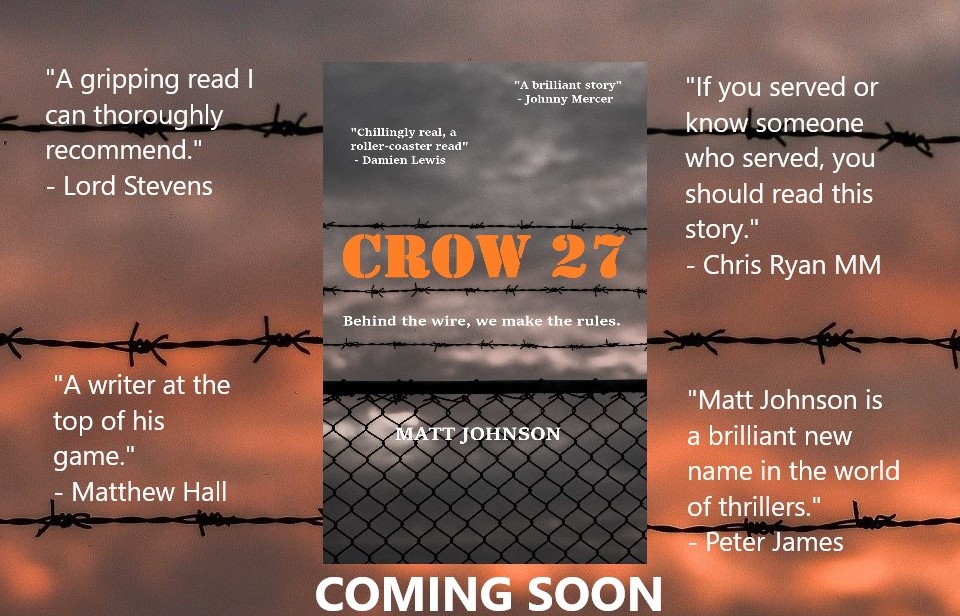
The picture displays the front cover of my new book and some of the quotes from people who have read it. Lord Stevens is John Stevens, the former Met Commissioner. The names Chris Ryan, Peter James and Matthew Hall should be well known to you. The jacket quotes from Johnny Mercer and Damien Lewis were unexpected and generous, decisions by them I am very grateful for.

It’s been some considerable time since I wrote a post for this blog and, during that period, we’ve seen events unfolding around the world that none of us would have predicted. As many writers before me have said, you couldn’t have made it up, and if you had, no publisher would have printed it.

Publish and be damned I’ve come to realise is an outdated expression from a time when editors were braver and publishers less cost conscious. Stories of incredible, unbelievable world events aren’t the only stories that struggle to get published. Stories that can’t easily be boxed into a particular genre, stories that don’t easily align with a publisher’s reader demographic. Stories that push boundaries. Publishing such novels involves risk, something the commercial world of publishing is increasingly constrained from embracing.

Today, I’m going to explain how Crow 27 came into existence and the challenges I experienced trying to get this particular story out there. This isn’t a short blog and for that, I apologise. But I hope you’ll bear with me and read on.

Some years ago, during a crime fiction literary event at Deal in Kent, I was one of a panel of authors answering questions from an audience of around two hundred people. We were asked by one audience member to identify a subject not covered in crime fiction that we thought crime writers should be tackling. I spoke about criminality in the armed services and the impunity with which some criminals operate behind the wire of some military camps. I briefly described what I knew of the abuse, bullying and sexual exploitation, mostly – but not exclusively – of young women soldiers and the failure of the Ministry of Defence (MOD) and the Army to effectively address the problem. I spoke of the levels of unreported crime, of the lack of victim confidence in a system that has been demonstrated time and again to be loaded against them. When I finished speaking, there was a surprisingly long and enthusiastic period of applause. Deal, of course, remains a town with a significant military interest but I knew then, this was a subject I needed to write about one day. 

Not long after beginning to research the topic, I was invited to an event for military veterans when I met Tina, a former army Captain who had served at Deepcut training barracks in Surrey at a time when several young recruits died, supposedly as a result of suicides. You may recall the BBC Panorama documentary ‘Bullied to Death‘ that first exposed the number of questionable suicides of young soldiers that had occurred at Deepcut in the late 90s and early 2000s.

Tina told me her story, something she had kept to herself for many years, partly due to the severe mental illness she experienced as a result and partly due to a non-disclosure agreement (NDA) the MOD insisted she sign before she was medically discharged from the army. 

One night, after leaving an officer’s mess at a barracks in Germany, Tina walked to her accommodation. She was drunk, the evening having been spent with her fellow junior officers in the bar at the mess. Arriving at her room, she threw her clothes onto the floor, lay down on the bed and fell asleep. A short while later, she was disturbed by a noise in her room. She woke to find a man on top of her. He was wearing a balaclava mask and he ordered Tina to keep quiet or he would use the bayonet he was carrying to kill her. 

Tina was raped and subject to a series of degrading sexual assaults. Her attacker was an NCO, a sergeant from the same camp she was posted to. He was caught soon afterwards. At his trial, he maintained his innocence, claiming what had happened had been consensual. The military trial was presided over by a male judge and the entire jury was made up of male army officers. The sergeant was acquitted. 

Tina sued the MOD. She was offered an out of court settlement provided she signed an NDA. By this time, she had been posted to Deepcut barracks. One day, she was in her office when the sergeant who had attacked her appeared in the same building. Despite promises to the contrary from the army, he had been posted to the same camp as her. Tina had a breakdown and was admitted to hospital. She suffered psychosis, PTSD and chronic depression. She never recovered. In 2019, while helping me write a novel inspired by her experience, she died of a heart attack brought on by the medication she had been taking for her psychosis. She was just forty-two years old. She left a young son. After her death, her family asked me to write a eulogy to be read at her funeral. It was an honour to do so. The funeral was attended by several hundred people, many of whom were friends of Tina’s and members of ‘The Sisterhood’, a secretive – although not secret – support group of women soldiers I learned now numbers several thousand serving and retired servicewomen. 

Later, I met Anna. Anna is now in her forties and spent many months at Deepcut barracks as a recruit soldier in the late 1990s. During this time, Anna was the subject of a great deal of attention from non-commissioned officers who were supposed to be supervising her and her fellow recruits but seemed more interested in bedding them. Anna came in for a lot of attention because she was particularly attractive and because she resisted the overtures of the NCOs. One week, Anna’s closest recruit friend unexpectedly failed a physical fitness test that would see her discharged from the army. Anna’s friend was devastated. Anna was then approached by the NCO responsible for her friend’s failure. It was made clear to Anna that the failure was a set up. The deal on offer was the result for her friend would be changed to a pass provided Anna would agree to sleep with the NCO. Anna reluctantly agreed. She was raped and sexually humiliated. The rape was filmed and then used to blackmail her into doing the same for other NCOs. Only when they became bored with her did they allow her a posting away to a new Regiment abroad. 

Anna had never revealed her story to anyone before me. Her friend does not know what was done for her. She is aware the friend is likely to read Crow 27, will recognise the scenario and will know. Anna understands that and told me it will be worth it in order that people know the truth.  

And then, at a conference I’d been invited to speak at on the subject of slave trafficking, I found myself sitting with a man called Paul Kenyon. Paul asked me about future writing projects and I told him what I was working on. It was then he revealed he was a BBC Producer and had been part of the team that produced ‘Bullied to Death’. He offered to introduce me to Jane MacSorley, the Director of that Panorama programme. It was as if fate had leant a hand.

Background – is this a contemporary issue or old news? 

Although Crow 27 is set in 2005, the issue of abuse, bullying and sexual exploitation of recruit soldiers remains a problem for the British Army of 2022. Sadly, little has changed and, until sufficient pressure is placed on those with the power to introduce real change, until the public are fully aware of what goes on behind the wire, it’s certain nothing will. In 2016, the UK Government introduced the Service Complaints Ombudsman for the Armed Forces to replace the office of the Service Complaints Commissioner who produced annual reports but had far fewer powers. In each annual report since then, the Ombudsman has expressed concern at the over-representation of BAME people and women in the Armed Forces in the complaints system and the possible causes. In her first annual report of 2016, the Ombudsman said this –

The Ombudsman is concerned about the continued overrepresentation of both female and Black, Asian and Minority Ethnic (BAME) Service personnel in the Service complaints system Tri-Service. The disproportionate representation of female and BAME personnel as complainants (21% and 10%) compared to representation in the Armed Forces (11% and 7%) not only continued for the third consecutive year, but actually increased for female personnel. Bullying, discrimination and harassment were more commonly the cause of complaints for these groups. 

The Ombudsman also recommended the Ministry of Defence (MoD) commission a study by the end of April 2018 to determine the root causes of the overrepresentation of female and BAME personnel in the Service complaints system and that appropriate action was taken to try and redress the situation by the end of December 2018, including putting the appropriate support mechanisms in place. The MoD failed to act on that recommendation. In her 2020 report the Ombudsman wrote this in her report: 

‘’Female personnel had nearly twice the rate of Service Complaints than males. Although this over-representation was found in all complaint categories, it was primarily driven by bullying, harassment or discrimination. The rate at which female Service personnel raised bullying, harassment or discrimination Service Complaints was four times larger than the equivalent figure for male Service personnel. The rate of reported bullying, harassment or discrimination Service Complaints by female personnel has not changed by a significant amount in the last three years. 

In 2022, the Army conducted a survey of soldiers that revealed there had been an observable increase in the reporting of targeted sexualised behaviours, behaviours that include coercive sexual favours and assault. Especially shocking was the proportion of service personnel saying they had suffered a ‘particularly upsetting experience’, which has significantly increased since previous surveys in 2015 and 2018. In 2018, 15% of servicewomen reported a particularly upsetting experience (already an increase from the previous survey in 2015). In 2022, 35% of servicewomen reported a particularly upsetting experience in the previous 12 months.  The figure for men is 13% (up from 2% from the previous survey), also a huge increase. 

The reason for this is unlikely to be increased confidence in reporting because, as the survey shows, those people are not in fact reporting these experiences, they are disclosing them to an anonymous survey. The explanation, of course, is that things are getting worse, not better. Lots of the behaviours categorised as a ‘particularly upsetting experience’ are criminal offences. They include sending unwanted sexually explicit material, revenge porn and sexual assaults. They range from unwanted sexual touching to rape. The proportion disclosing rape doubled from 2% in 2018, to 4% in the 2022 survey. The vast majority (65%) reported not having told anyone of their experience. The survey noted, ‘there still seem to be significant barriers to reporting sexual harassment, including ‘the perceived negative repercussions of making a complaint’. In 77% of reported examples, the perpetrator was male. Sexualised misbehaviour remains a common experience in the Army with women far more likely to experience it than men. 

So, there we have it. It’s the reality behind the formation of the Centre for Military Justice, behind the Liberty campaign, behind the Government Select Committee inquiry and behind the bravery of those who were prepared to tell me what had happened to them while serving.

Crow 27 was inspired the experiences of Tina, Anna and others with similar tales,  and by their bravery in being prepared to tell me their stories. While researching and writing, I met and spoke to many young men and women who described shocking, life-changing experiences that occurred during their formative months as soldiers. On several occasions, I nearly stopped, so ugly and upsetting were the stories of bullying, sexual abuse and similar behaviours. The responsibility to represent their accounts, authentically and with honesty, weighed heavily on my shoulders. 

During the research phase of the book, I was advised by several contributors that I would struggle to persuade a publisher to invest in this story. The explanations for that view were varied. Some considered that fear of the MOD would inhibit, others thought it unlikely to be thought of as a contemporary issue – this type of thing doesn’t still go on, does it? One or two thought the simple reality of commercial viability would see publishers concluding that a story about the abuse of young, female soldiers wasn’t likely to sell.

They were right. Although feedback and comment on the quality of the story was excellent with one editor describing the book as the best exposé he’d read since Heart of Darkness, commercial opinion on the subject matter was exactly as predicted – the story wouldn’t sell books.

Faced with this level of rejection, I went through a period of reflection. I didn’t write this story to sell large numbers of books. I wrote it for the victims, so their stories would be known. I wrote it to expose the reality of what happens behind the wire. I wrote it so that people who read the content would learn about it and understand. For this reason, I’ve decided to follow a path many writers have been advocating on social media for some considerable time, to become an indie publisher, a hybrid author.

During the last few weeks, I’ve negotiated a steep learning curve in the use of MS Word, typesetting, jacket design and the use of picture editing software. It’s been fun, and seeing the result of your work appear in digitalised proof formats has proved to be an exciting experience. Will it work? Who knows. What I can say is Crow 27 will be published later this month through Amazon. As soon as it’s live, I will share the link with you.

I hope you enjoy reading it. 

Best, as always

Matt.

A promise never forgotten – John Murray’s 37 year fight for justice

If you’re reading this, there’s a good chance it’s as a result of seeing the post on the Facebook ‘Campaign for justice for WPC Yvonne Fletcher’ page and you’ve followed the link. If not, no matter. The fact you’ve landed here is enough for us to say thank-you.

On 17th April, 1984, Yvonne was helping to police a demonstration outside the Libyan People’s Bureau in central London. She was shot in the back by someone who opened a window in that building and then fired a machine gun at the crowd. The photograph above was taken very soon afterwards. Cradling Yvonne is PC John Murray.

John accompanied Yvonne to hospital in the ambulance. She was still conscious at this time and, rather than complain and focus on her own extraordinarily painful wounds, she did her best to give reassurance to those other casualties who were also being transported – many of whom had life-changing injuries.

In the ambulance, while talking to Yvonne, John made a promise to her; that he would not rest until whoever had shot her had been brought to justice.

At the hospital, John waited patiently while Yvonne was in surgery. He was the first to receive the news of her death.

Thirty-seven years on, with all criminal avenues of prosecution seemingly now exhausted, John is close to fulfilling his promise.

John needs your help.

Late in 2021, John will be pursuing a private civil action against a man alleged to have been part of the conspiracy to murder Yvonne Fletcher.

This is John’s final chance, the last throw of the dice in what has been a long and arduous campaign. John has taken immense personal risk, both physically and financially, to reach this point. He’s not suing the perpetrator for money, he’s suing for £1. It’s a symbolic amount but it means, if he wins, there is a finding against someone responsible for Yvonne’s death.

The news this week that the Police Federation (PFEW) will be supporting John’s action came as a tremendous lift. But, John’s need for help doesn’t end there. He could lose. If he does, the PFEW can’t cover any claim for costs made by his opponents. John’s lawyers set up a Crowd Justice campaign which, to date, has raised £36K. But, this amount (and any more added to it) will be deducted from any contribution the PFEW make to John’s legal costs.

John is not wealthy. He has a £60K costs protection limit order in place, but that’s still a huge risk for him to be taking.

You can help. We’re asking for something unusual. We’re asking you to contribute to the costs John has personally incurred travelling to Libya, interviewing witnesses and all the associated costs this has involved reaching this point. We don’t want you to contribute to the cost of the court case – that is being covered by the PFEW and CrowdJustice fund.

On the day Yvonne was killed, she was just 25-years old. So, we’re asking that on 17th April, 2021, you donate £25 to John. The Facebook Campaign page has nearly six-thousand followers. If everyone pitches in …

The details of the account are as follows

Bank; HSBC

Account name; Justice 4 Yvonne

Sort code; 40-24-13

A/c number; 51720422

On 17th April for payment, don’t forget. Make sure to tick the ‘business’ box when setting up the payment. This account is administered by the Campaign support team.

It’s also important to note, John didn’t ask for this request. He doesn’t know it’s going out. It will be a surprise, we hope a good one. And we hope, like us, you will use this opportunity to say thanks to him for the efforts he has put in to ensure justice for a fallen colleague. A promise never forgotten.

Let’s give John a surprise. Let’s show him we care too.

John Murray at the memorial to Yvonne Fletcher in St James’s Square, London.

I’m done too.

In the last twenty-four hours, over a quarter of a million people have read the ‘I’m done‘ post. One cop wrote to me anonymously. These are their words.

I’m done too.

I’m done with the self-appointed monitors of policing who feel it’s their place to photograph, video and (sometimes) selectively edit recordings of police doing their jobs. I’m done with people who misrepresent the truth for publicity, to self-promote and, sometimes, for mischief. I’m tired of people who value ‘likes’ on their chosen social media platform above helping a lone officer struggling to detain a violent person. I’m done with the cowards in society who would rather film a cop being beaten up than pitch in to help him or her. I’m done with people who ‘know their rights’ and who consider that (often mistaken) knowledge is sufficient justification to kick, punch and spit at police officers.

I’m done with people who tell us to do more stop-and-search in response to escalating knife crime but who then criticise us when the criminals who get caught as a result bleat about having their civil rights breached.

I’m done with criminals using the complaints system and legal process to intimidate hard working cops. Yes, that is what happens. Criminals use both to try and make it easier to continue with their activities, uninterrupted. And I’m done with the payouts made to criminals because our legal system has created a situation where firms of lawyers can tout for business, encourage civil actions and know their clients will get paid out because it’s actually cheaper for the police to do that than fight the case – regardless of the result.

I’m done with an organisation where the policy is to punish rather than forgive, to discipline rather than teach. I’m done with fearing if I make a mistake that I will be punished rather than have my employers accept I hadn’t been taught or trained as well as I should have been. And, while I’m on that subject, I’m angry too. I’m angry that Hendon, the flagship of police training, has been demolished and sold off to developers. That the swimming pool where officers were taught life-saving techniques is now gone. That the sports facilities, the gymnasiums, the canteens, even the police stations themselves are all gone. The police section houses are gone. Even New Scotland Yard was demolished and the site sold.

I’m done with being photographed and criticised – sometimes, even fined – for using a public cafe to eat when all the police canteens have gone. I’m done with having to travel across London to one of the few remaining custody suites where prisoners can be processed and where we have to wait in a huge queue to have a detained person booked in. I’m done with being asked by my supervisors not to arrest people because that means I will be off the ground, unavailable and the calls will soon build up.

I’m tired of trying to do the job to a standard the public has a right to expect but that forty-thousand more us used to be available to do. Think about that for a minute. Forty-thousand less police officers in the UK than there were ten years ago. And all because one Home Secretary considered the ‘role of the police is to fight crime, nothing more, nothing less.’ So, when I’m directing traffic, helping someone find their lost child, trying to find a missing person, supervising a demonstration or football crowd, or many of the other non-crime related roles that fall to the police, I’m reminded that one politician decided society needed less cops.

But, you know what? I’m not so tired I’m about to give up. Because I still believe in working for a better society. The reasons I became a police officer are still valid. I still want to help people. I still want to put bad people behind bars. Policing has to be accountable, I don’t know of a single colleague who doesn’t agree with that. But what I do ask is to be given the tools, the facilities, the support and the means to be able to do my job. Is that too much to ask?

Because being a cop is far more than simply fighting crime.

Thank you for taking the time to read these posts. Whether they will do any good remains to be seen. But, as we read above, police morale is dented but not beaten.

I was taught, way back in 1978, about the meaning of the word ‘police. It means, ‘generally, the arrangements made in all civilised countries to ensure the inhabitants keep the peace and obey the law. It also denotes for force of peace officers, or police, employed for this purpose.’ If I recall correctly, those were the opening words from the police instruction manual of the time. Members of our police services are members of the public one day, a cop the next. Our police services police with our consent, not by coercion, as we see too often around the world. That places us in a very fortunate situation but it is one that comes with responsibilities. If we want our police to function, their role must be supported, not weakened. Because if we weaken it by too much, we are on the road to anarchy. And then we may see a style of policing result that has happened abroad and which we must not countenance here.

And, while you’re here. Can I make a special request. I’m helping an old colleague pursue a murder case. It happened in 1984 and involved the shooting of a serving WPC. You may remember it. Her name was Yvonne Fletcher. This is a link to a crowdfunding page. If you’d like to help a veteran cop secure justice for a fallen friend, please consider donating a few quid. If he reaches his target, it’ll certainly go a long way toward reminding those on the thin blue line that they are supported. We do have their backs.

Thank you. For both your support and your time.

Matt.