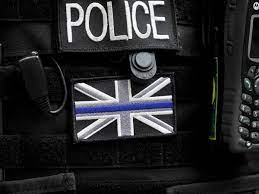
The recent decision by the Metropolitan Police to ban the wearing of the thin blue line badge has stirred significant controversy and debate. A symbol that has traditionally been used to represent solidarity and support for law enforcement officers, and a salute to those killed in the line of duty, the thin blue line badge, featuring a black-and-white union flag with a blue line, has become a popular national symbol representing the role of law enforcement as a barrier between the monsters and the weak, a force separating society from chaos and disorder. Supporters argue the badge symbolises respect for the fallen and appreciation for the difficult and often dangerous work performed by police officers.
And, I would argue, to assess the probity of this badge or patch, it is very relevant to consider when and how the expression ‘thin blue line’ first became popular. It was about twenty years ago when a United States marine called Michael Marks wrote a poem by that name, reputedly while sitting in a shell-hole during a tour of Iraq. The poignant ending to that poem resulted in it becoming hugely popular in policing and military circles.
These are final words of that poem; –

The decision by the Met to ban the public wearing of this patch at a demonstration has prompted discussions regarding the implications of its display, potential political affiliations, and its impact on community relations. In February this year, it was reported that a Nottingham based police officer had been referred for possible disciplinary action following a complaint by a member of the public alleging the thin blue line patch he had been wearing was now ‘associated with racism’ following its misuse at a protest against a Black Lives Matter rally in the United States. Rather than choosing to robustly defending the officer concerned or to point out that no such association exists in the UK, local senior officers chose to ban all local officers from wearing the patch.
It wasn’t long before political agitators and critics of the police jumped on the bandwagon to use this precedent to attack other police services in the UK. Their rather disingenuous argument maintained the suggestion that the thin blue line symbol had increasingly been associated with the aforementioned undesirable political ideology present in the US. It was said that, in some instances, the patch has been adopted by groups with controversial or divisive agendas, leading to concerns about the potential for the symbol to be seen as a statement of opposition to a number of social justice movements. If the police wore the patch, it was claimed, they were associating themselves with that ideology.

As Nottingham had done before them, senior officers in the Met caved in to this view. The ban they imposed appears to be an attempt to address concerns about perceived bias or favouritism within law enforcement, their acceptance being that the display of the badge could indeed suggest an affinity with such ideologies and, therefore, a lack of impartiality and fairness that could erode trust between the police and the communities they serve.
Not all Chief Officers have shared this view with one or two of the bravest being prepared to stand up and defend the badge for what it truly represents. The Met decision, however, raises complex issues surrounding symbolism, political associations, community relations, and trust. While the ban may be intended to address concerns about bias and impartiality, it also risks alienating officers and their supporters, driving a wedge between rank and file officers and management. Is it the case that the hijacking of a police patch by a group in the United States should have such an immediate and telling impact on thinking and decision-making in the UK? Is this a reflection of the manner in which policing has become increasingly influenced and controlled in accordance with political expediency rather that public desire and need? Or is this a line in the sand, a point at which the police service needs to stand up and be counted?

Even twenty years ago, the police service in the United Kingdom was regarded as a pillar of impartiality and professionalism. In recent years, however, concerns have been raised in many quarters over the increasing politicisation of the police, their priorities, their style of management, their performance and their ability to deliver the quality of service the UK public is entitled to expect.To understand the current state of affairs, it is important to examine the historical context. The UK’s police service once operated with a strong emphasis on political neutrality and independence. This principle was enshrined in what the Baroness Casey report recently referred to as ‘Peelian Principles’, reputedly established by Sir Robert Peel, the founder of modern UK policing.
Factors such as increased political scrutiny, constraining legislation, the introduction of Police and Crime Commissioners, budget cuts, and government demands for specific outcomes have raised justified concerns about the erosion of police independence.
Several incidents have highlighted the politicisation of the police service. One notable example is the handling of very kind of demonstration that saw the removal of thin blue line patches. The police’s inconsistent response to politically charged gatherings has drawn criticism, with accusations of biased treatment based on political leanings. This has fuelled concerns the police are being directed to prioritise political considerations when maintaining public order with what might be described as ‘light-touch’ policing applied only where political expediency supersedes a need to maintain public order.
The appointment of senior police officers has also come under increasing scrutiny. Critics argue that the selection process is now too greatly influenced by political considerations, compromising the meritocratic principles that should guide these appointments. Similarly, the ease with those Chief Officers who have demonstrate a reluctance to accede to the demands of their political masters, have been dismissed has contributed to a growing feeling that the credibility and independence of the police service is effectively compromised. Toe the line, Chief Constable, or I’ll replace you with someone who will.
The politicisation of the police service has had far-reaching consequences for public trust and confidence. The impartiality and fairness of the police are fundamental to their effectiveness in maintaining law and order. When the perception of bias (for whatever reason) takes root, public trust in the police is eroded. This can lead to reduced cooperation, reluctance to report crime, and a breakdown of community relations – all factors we see present in today’s society.
Several factors have contributed to the politicisation of the police service. One is the increased centralisation of power in policing, with policy being set and decisions being made at national level rather than locally. This concentration of power has made the police service more susceptible to political interference. Another is budget cuts which have put pressure on police forces, making them more vulnerable to political influence. When resources are limited, there is inevitable temptation to prioritise certain issues or appease political interests to secure funding or support.

Is it too late?
To address the issue of politicisation, it is crucial to reinforce the principles of independence, impartiality, and accountability within the police service. This might be achieved through greater transparency in decision-making processes, robust safeguards against political interference, and clear guidelines on the handling of politically sensitive situations. Moreover, a renewed commitment to the training and education of both politicians and police officers on the importance of political neutrality and impartiality is essential. This would help foster a culture that values professionalism and integrity above political considerations. The issue preventing this, however, is political will. Now our police service has been brought under political control, will our politicians ever be prepared to allow it to regain its independence?
Or is the banning of the Thin Blue Line badge a symptom of a service broken beyond repair?
For more on the history of police independence, when the Peelian principles were first brought into question and how our police services were systematically brought under political control, please do read No Ordinary Day – how one of the greatest tragedies in UK policing history triggered the end of an independent UK police service.
 Matt Johnson
Too true. Too much political interference in Policing culminating in the obnoxious Police & Crime Commissioners role. And what a mess they are making of it.
LikeLiked by 1 person
Well said. Politics has been the ruin of the police, taking the knee and rainbow badges are allowed but not the thin blue line. Get back to locking up the bad guys. I’m so glad I’m out of it when I hear the stories of what is happening inside the force now. Old codger talking!!
BTW thin blue line traces back to here https://www.kiplingsociety.co.uk/poem/poems_tommy.htm
LikeLike
Well written. Politics should not be post of policing, just stick to locking up the bad guys. I’m so glad I’m out of it now.
BTW thin blue line traces back to here https://www.kiplingsociety.co.uk/poem/poems_tommy.htm
LikeLike